Understanding which security awareness metrics truly matter can transform your cybersecurity program from a compliance checkbox into a strategic risk management tool that protects your organization and enables business growth.
Why Security Awareness Metrics Are Critical for Risk Management
Despite significant investments in firewalls, encryption, and endpoint protection, organizations continue to face devastating security incidents. The reason is clear: even the most sophisticated infosec infrastructure becomes a house of cards when employees lack cybersecurity awareness. Recent industry data shows that 95% of cybersecurity breaches involve human error, making security awareness training not just beneficial but essential for organizational resilience.
For small and medium-sized businesses, the stakes are particularly high. Without dedicated security teams or substantial budgets for advanced threat detection, SMBs must rely on their employees as a critical layer of defense. Yet many organizations struggle to show the tangible value of their security awareness programs, treating training as a compliance requirement rather than a strategic risk-management initiative.
Security awareness metrics provide the quantifiable evidence needed to transform this perspective. By measuring specific behaviors and tracking improvement over time, organizations can identify vulnerabilities in their human defenses before attackers exploit them. These metrics help CFOs and executive leadership align cybersecurity investments with financial risk management objectives, showing how employee awareness directly impacts the bottom line through reduced incident costs, maintained business continuity, and stronger regulatory compliance.
Key Performance Indicators That Reveal Your True Security Posture
Effective security awareness measurement extends beyond simple training completion rates. While tracking who has completed required modules provides basic compliance documentation, it offers no insight into whether employees can actually identify and respond to threats appropriately. Organizations need KPIs that show real behavioral change and risk reduction.
Training engagement metrics provide the first layer of meaningful insight. These include assessment scores, time spent on training materials, and knowledge retention rates measured through periodic testing. However, the most revealing indicators measure real-world application. Incident reporting rates demonstrate whether employees feel empowered to flag suspicious activity, while the accuracy of those reports shows whether they can distinguish legitimate threats from false alarms.
Policy compliance metrics offer another critical dimension. Track adherence to password policies, multi-factor authentication adoption rates, and proper handling of sensitive data. For organizations pursuing frameworks like NIST, CMMC, or SOC 2, these metrics directly support compliance validation efforts. Additionally, monitor the frequency and severity of security policy violations, as patterns may indicate gaps in training content or delivery methods that require remediation.
Response time metrics reveal organizational agility in the face of threats. Measure how quickly employees report suspected phishing attempts, how rapidly IT teams respond to security incidents, and the time required to contain and remediate security events. These temporal measurements help quantify the operational efficiency of your security awareness program and identify bottlenecks in incident response processes.
Measuring Human Risk: Phishing Simulation and Response Metrics
Phishing remains the most common attack vector targeting organizations of all sizes, making phishing simulation metrics among the most valuable indicators of human-related cyber risk. Regular simulated phishing campaigns provide controlled environments to measure employee susceptibility to social engineering attacks without the consequences of actual breaches.
The phishing click rate represents the percentage of employees who click on simulated malicious links or attachments. Industry benchmarks suggest initial click rates often exceed 30% for organizations without established awareness programs, while mature programs achieve rates below 5%. However, the trend matters more than any single measurement. Organizations should track this metric quarterly to identify whether training interventions produce sustained behavioral improvements or merely temporary compliance.
Equally important is the credential submission rate, which measures employees who not only click the link but also enter login credentials on simulated phishing pages. This represents a more severe security failure, as attackers who capture credentials can immediately access corporate resources. Organizations should separately track and prioritize remediation for employees who submit credentials, as they represent the highest-risk individuals requiring targeted intervention.
The reporting rate reveals the percentage of employees who actively flag and report suspected phishing attempts to security teams rather than simply deleting or ignoring them. High reporting rates indicate a mature security culture in which employees see themselves as active participants in organizational defense. Best-in-class organizations achieve reporting rates above 60%, turning their workforce into a distributed threat-detection system. Track time-to-report metrics as well, since early detection and rapid response significantly reduce the potential impact of successful phishing campaigns.
Repeat offender tracking identifies individuals who consistently fall for simulated attacks despite remedial training. These employees may need additional support, alternative training methods, or even restricted access to sensitive systems, depending on their role and the organization's risk tolerance. Documenting these patterns also provides valuable data for risk assessments and helps justify investments in enhanced security controls for high-risk user populations.
Translating Awareness Data Into Actionable Risk Reduction Strategies
Collecting security awareness metrics provides value only when organizations translate data into concrete risk reduction actions. The first step involves establishing baseline measurements and realistic improvement targets. Organizations new to security awareness training should expect gradual behavioral change, not immediate transformation. Set quarterly goals that reflect incremental progress, such as reducing phishing click rates by 5-10% per quarter or increasing reporting rates by 15%.
Segment your workforce by risk profile and tailor interventions accordingly. Employees with access to sensitive financial data, controlled unclassified information, or personal health information represent higher-value targets for attackers and require more rigorous awareness training. Similarly, departments with historically higher incident rates need additional support. Use metrics to identify these high-risk populations and allocate training resources proportionally to the risk they represent.
Integrate awareness metrics into your broader risk management framework. CFOs and executive leadership increasingly expect cybersecurity to demonstrate quantifiable business value. Translate awareness improvements into financial terms by calculating the potential cost of breaches prevented through enhanced employee vigilance. Factor in incident response costs, regulatory fines, business disruption, and reputational damage. This financial perspective enables cybersecurity to participate meaningfully in enterprise risk governance discussions.
Deploy just-in-time training interventions triggered by specific user behaviors. When employees click simulated phishing links, immediately provide brief educational content explaining the indicators they missed. This contextual learning reinforces concepts more effectively than annual training sessions disconnected from real situations. Track the effectiveness of these interventions through reduced repeat offender rates and improved performance on subsequent simulations.
Collaborate with managed service providers and virtual CISO services to benchmark your metrics against industry peers and identify areas for improvement. Organizations often lack the internal expertise to interpret awareness data effectively or understand what constitutes strong performance for their industry and size. External cybersecurity partners bring comparative insights that help organizations set appropriate targets and avoid investing resources in areas where they already perform adequately.
Building a Continuous Monitoring Framework for Security Awareness
Security awareness cannot function as an annual training event but requires continuous monitoring and reinforcement. Establish a measurement cadence that provides regular visibility into human-related security risks without creating excessive administrative burden. Most organizations benefit from monthly metric reviews, quarterly comprehensive assessments, and annual program evaluations.
Implement automated data collection wherever possible. Modern security awareness platforms integrate with email systems, learning management systems, and security information and event management (SIEM) solutions to capture relevant metrics without manual intervention. For organizations implementing Microsoft Sentinel or similar centralized log management solutions, incorporate security awareness events into your monitoring dashboards alongside technical security metrics for comprehensive risk visibility.
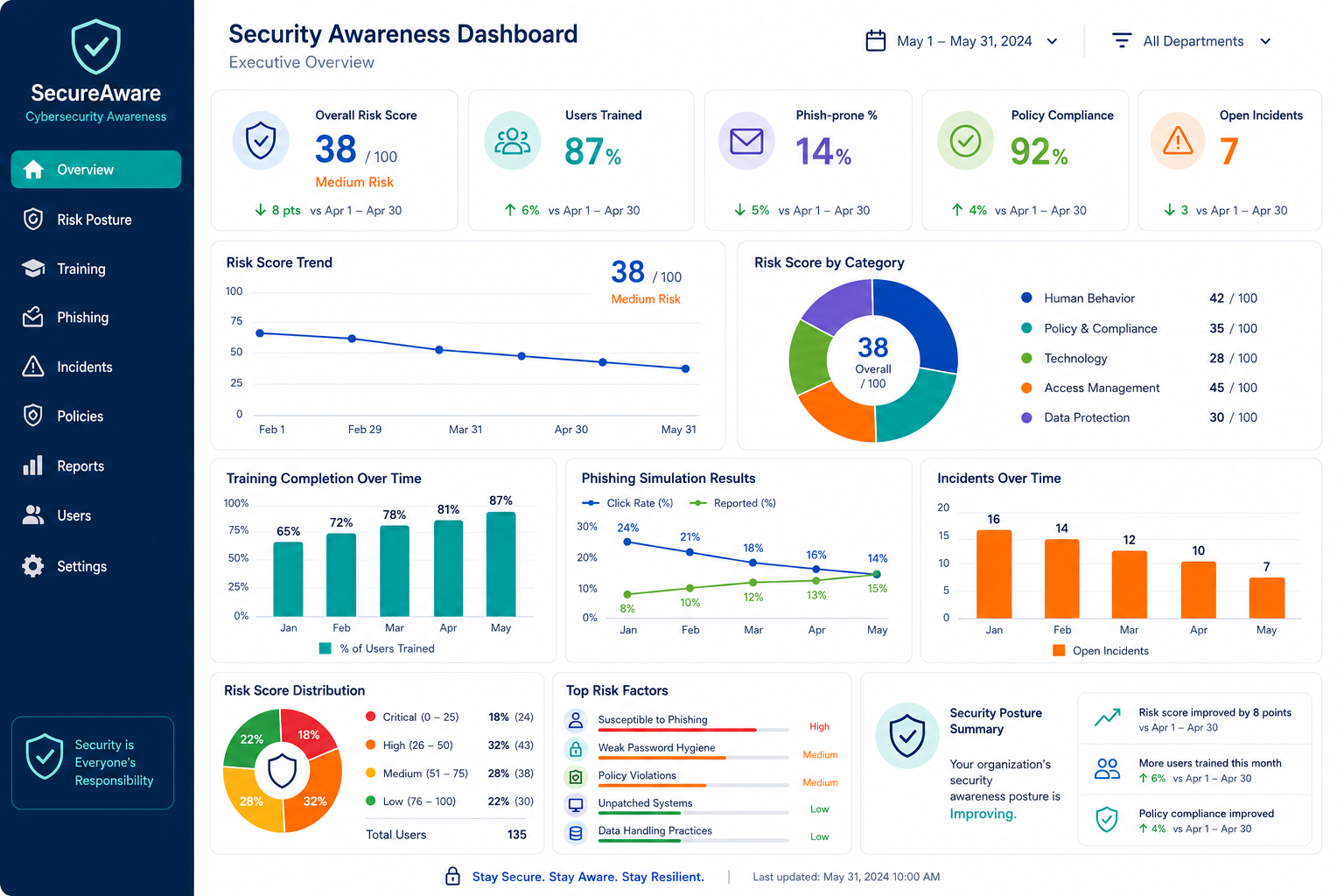
Create executive dashboards that communicate security awareness posture clearly to non-technical stakeholders. Present trends over time rather than point-in-time measurements, use visual representations that immediately convey risk levels, and contextualize metrics with industry benchmarks or historical performance. These dashboards help executives meet governance responsibilities while showing how cybersecurity investments support business objectives.
Establish feedback loops that connect awareness metrics to program improvements. Conduct regular reviews of training content effectiveness by correlating specific modules with performance on related simulation scenarios. If employees consistently fail to identify particular attack techniques, update training materials to address those gaps. Similarly, survey employees on training relevance, clarity, and practical applicability to identify opportunities to boost engagement.
Build accountability mechanisms that extend beyond the security team. Department managers should receive regular reports on their teams' security awareness performance and bear responsibility for addressing persistent issues. This distributed accountability model scales more effectively than centralized security teams attempting to manage awareness across entire organizations. Provide managers with resources and guidance to conduct security conversations with their teams, turning awareness from an IT initiative into an organizational priority.
Plan for long-term program maturity. Organizations typically progress through distinct stages: establishing baseline metrics, developing consistent measurement practices, integrating with risk management processes, and ultimately transforming into a continuous improvement program that adapts to emerging threats. Document your current maturity level and create a roadmap for advancement. This strategic perspective helps maintain momentum during periods when metrics plateau and demonstrates ongoing commitment to stakeholders.
Security awareness training is one of the most cost-effective risk-reduction strategies available to organizations, particularly small and medium-sized businesses with limited security budgets. However, realizing this potential requires moving beyond compliance-driven training toward strategic, metrics-informed programs that measurably reduce human-related cyber risk. Organizations that embrace this measurement discipline can detect and respond to security incidents rapidly, maintain regulatory compliance, and build resilient cybersecurity programs that support rather than impede business growth.
.jpeg) Michael Markulec
Michael Markulec
.jpeg?width=30&name=0%20(7).jpeg) Michael Markulec : Feb 24, 2023, 9:28:00 AM
Michael Markulec : Feb 24, 2023, 9:28:00 AM