As cyber threats increasingly impact financial performance and business continuity, CFOs are emerging as critical partners in building resilient security programs that protect the bottom line while enabling growth.
Why Cybersecurity Is Now a Financial Imperative for CFOs
The financial implications of cybersecurity incidents have shifted from theoretical risks to tangible threats that directly affect the balance sheet. In today's digital economy, CFOs are discovering that cyber events trigger immediate and measurable consequences: operational downtime that halts revenue streams, regulatory fines that drain reserves, legal costs that accumulate rapidly, and brand damage that depresses valuations. According to industry research, the average cost of a data breach now exceeds $4 million, and small- to medium-sized businesses face potentially existential consequences from a single significant incident.
Beyond direct incident costs, CFOs must now account for cybersecurity's growing influence on key financial metrics and business operations. Cyber insurance premiums continue to rise sharply, particularly for organizations without demonstrable security controls. Customer contracts increasingly mandate specific security certifications and compliance frameworks, making cybersecurity a prerequisite for revenue opportunities rather than a back-office concern. Investor due diligence now routinely includes security posture assessments, and M&A valuations factor in inherited cyber risk from legacy systems and technical debt.
This shift elevates cybersecurity from a purely technical domain to a core financial risk that demands C-suite attention. CFOs are uniquely positioned to translate cyber risks into financial terms that boards and stakeholders understand, bridging the gap between security teams focused on threats and business leaders focused on growth. The modern CFO must view cybersecurity investments not as discretionary IT expenses, but as essential components of financial risk management and business continuity planning that protect shareholder value and enable sustainable growth.
Quantifying Cyber Risk: Moving Beyond IT to Business Impact
Traditional cybersecurity conversations often remain trapped in technical jargon—discussing vulnerabilities, patches, and threat actors without connecting these concepts to business outcomes. CFOs bring a critical capability to security discussions: the ability to quantify risk in financial terms that drive decision-making. By translating abstract security concepts into concrete financial metrics such as potential revenue loss, recovery costs, regulatory penalties, and reputational damage, CFOs enable more informed resource allocation and prioritization across the organization.
Effective cyber risk quantification requires CFOs to work closely with security leadership to assess the organization's attack surface, identify critical assets, and model potential breach scenarios. This process involves evaluating which systems and data are most valuable to the business, determining realistic threat scenarios based on industry intelligence, calculating the financial impact of various incident types, and establishing key risk indicators that can be monitored over time. For example, a CFO might work with the CISO to determine that a ransomware attack affecting core financial systems could result in five days of operational downtime, translating to specific revenue loss, emergency response costs, and recovery expenses.
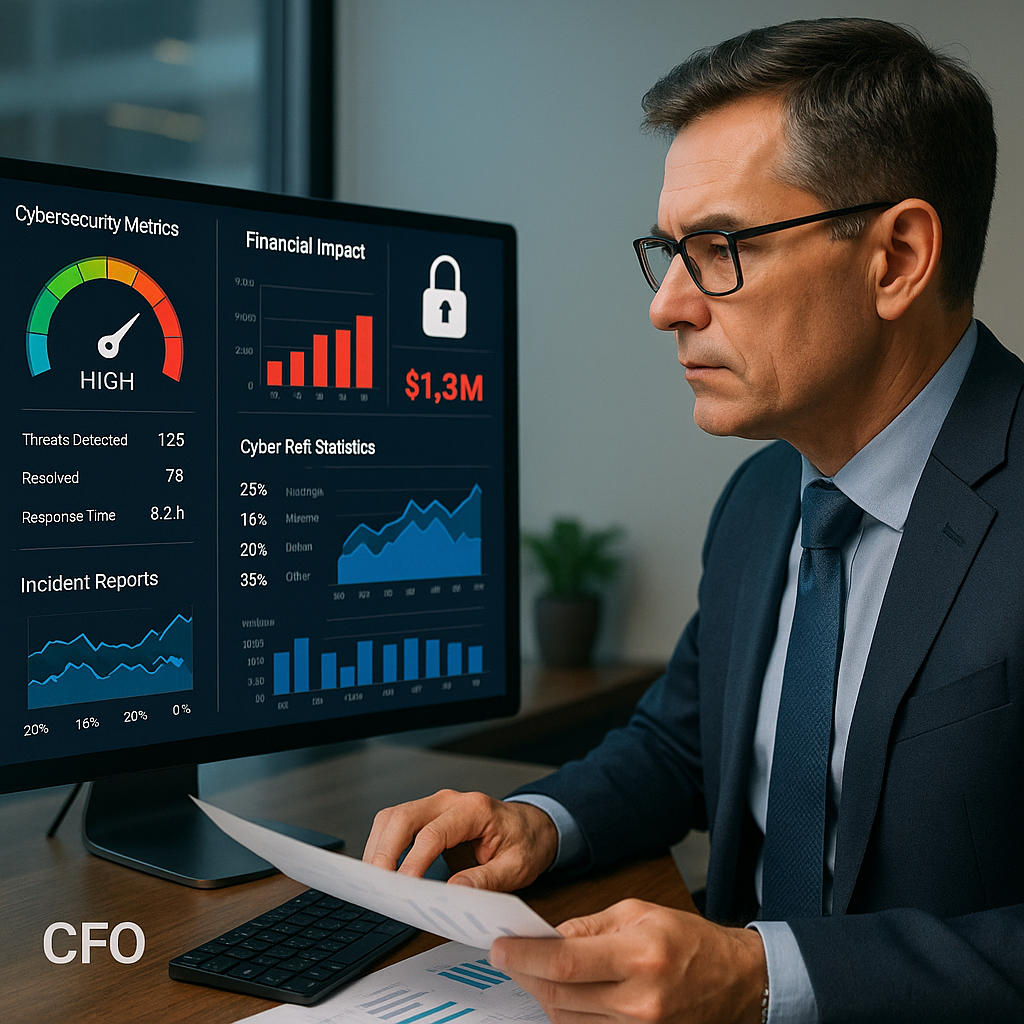
This quantification transforms cybersecurity from a compliance checkbox into a risk-management discipline aligned with enterprise risk management frameworks. CFOs can leverage methodologies such as the factor analysis of information risk (FAIR) or cost-benefit analysis to evaluate security investments against expected reductions in risk. By establishing clear metrics—such as mean time to detect threats, percentage of assets with current patches, or security incident frequency—CFOs create accountability and enable data-driven discussions about security posture. This financial lens helps organizations move beyond reactive security spending toward strategic investments that deliver measurable risk reduction and business value.
The CFO's Strategic Partnership with Security Leadership
The relationship between the CFO and Chief Information Security Officer (CISO) or equivalent security leadership has evolved from transactional budget approvals to a strategic partnership. This collaboration is essential because neither executive can effectively address modern cyber risk in isolation. Security leaders possess deep technical expertise and threat intelligence, but may struggle to articulate business impact and compete for limited resources. CFOs understand financial priorities and resource constraints but require security expertise to assess risks and evaluate control effectiveness.
A productive CFO-CISO partnership begins with establishing shared objectives and a common language. Regular strategic meetings should move beyond budget reviews to discuss emerging threats relevant to the organization's specific risk profile, the effectiveness of existing controls measured against business outcomes, resource gaps that create unacceptable risks, and alignment between security roadmaps and business growth initiatives. For small to medium-sized enterprises that cannot justify a full-time CISO, partnering with a virtual CISO (vCISO) provides cost-effective access to executive-level security leadership that can engage directly with the CFO on strategic matters.
This partnership extends to board communications, where CFOs and security leaders should present unified perspectives on cyber risk. The CFO's credibility with board members and ability to frame security issues in financial terms strengthen the CISO's requests for investment and policy changes. Together, they can demonstrate how security initiatives support business objectives—such as enabling new market opportunities, protecting intellectual property that drives competitive advantage, or meeting compliance requirements that unlock customer contracts. This strategic alignment transforms cybersecurity from a cost center into a business enabler that supports growth while managing risk.
Budget Allocation and ROI: Making Smart Security Investments
Security budget decisions pose unique challenges because traditional return-on-investment calculations don't always apply. Unlike revenue-generating investments where ROI can be precisely measured, security spending often prevents negative outcomes that never materialize—making the value difficult to demonstrate. CFOs must develop frameworks for evaluating security investments that account for risk reduction, compliance requirements, operational efficiency gains, and business-enabling capabilities, rather than seeking direct revenue attribution.
Smart security budget allocation begins with risk-based prioritization rather than checklist-driven or vendor-driven approaches. CFOs should work with security teams to identify the organization's most critical assets and highest-probability threats, then allocate resources accordingly. For many small to medium-sized businesses, this means focusing on foundational controls that deliver broad risk reduction: multi-factor authentication that prevents credential-based attacks, regular security awareness training that reduces phishing susceptibility, continuous monitoring and detection capabilities that identify threats early, endpoint protection that prevents malware execution, and regular vulnerability assessments that identify and remediate gaps before exploitation.
Evaluating security ROI requires considering both quantitative and qualitative factors. Quantitative measures might include reduced incident frequency and severity, lower cyber insurance premiums resulting from improved controls, avoided regulatory fines through compliance adherence, and decreased downtime from improved resilience. Qualitative benefits include enhanced customer trust and competitive differentiation, improved employee confidence in company systems, faster sales cycles when security certifications are in place, and reduced friction during M&A due diligence. CFOs should also consider the total cost of ownership for security solutions, including implementation costs, ongoing maintenance, and internal resource requirements. For budget-constrained organizations, managed security services and virtual CISO engagements often deliver better value than building comprehensive internal capabilities, providing access to enterprise-grade expertise and tools at a fraction of the cost of full-time staff.
Building Financial Resilience Through Proactive Cyber Risk Management
Financial resilience in the face of cyber threats requires moving beyond reactive incident response toward proactive risk management that builds organizational capacity to prevent, withstand, and rapidly recover from security events. CFOs play a central role in this transformation by ensuring that cybersecurity is integrated into business continuity planning, financial forecasting, and operational resilience strategies. This holistic approach recognizes that cyber incidents are no longer isolated IT problems but business disruptions that affect every aspect of operations.
Proactive cyber risk management comprises several key components within the CFO's sphere of influence. Business continuity testing and tabletop exercises validate that response plans work in realistic scenarios and that financial systems can be recovered within acceptable timeframes. Incident response planning establishes clear roles, communication protocols, and decision frameworks before crises occur, reducing chaos and financial impact when incidents happen. Cyber insurance procurement ensures appropriate coverage aligned with actual risk exposure, with CFOs working to secure policies that cover business interruption, regulatory fines, forensic investigation, and legal costs. Third-party risk management evaluates the security posture of vendors and service providers who have access to sensitive data or critical systems, recognizing that supply chain compromises represent significant financial exposure.
Building this resilience also requires cultural change that CFOs can champion. By emphasizing security as everyone's responsibility rather than solely the IT department's concern, CFOs help embed security awareness into daily operations. Regular reporting of security metrics to the board and senior leadership maintains focus and accountability. Investment in security awareness training and phishing simulation programs reduces the human vulnerabilities that attackers commonly exploit. For organizations in regulated industries or the defense supply chain, CFOs should ensure adequate resources for compliance initiatives, such as CMMC certification, that protect contract eligibility and revenue streams. Ultimately, the CFO's involvement in proactive cyber risk management transforms security from an expense that drains resources into a strategic capability that protects financial performance, enables business growth, and creates competitive advantage in an increasingly digital and threat-laden business environment.
.jpeg) Michael Markulec
Michael Markulec
.jpeg?width=30&name=0%20(7).jpeg) Michael Markulec : May 26, 2023 12:04:43 PM
Michael Markulec : May 26, 2023 12:04:43 PM
.png)